Follicle
The GHK hair-growth trial
There is a human result here. There is also another ingredient in the formulation, and a similarly named copper peptide elsewhere in the literature.
The formulation in the human trial
A 6-month trial in 45 men with androgenetic alopecia tested a complex of 5-aminolevulinic acid and the peptide glycyl-histidyl-lysine, or GHK. The participants had Norwood-Hamilton II-V hair loss. This was a topical combination formulation.
That last detail earns a place near the front of the story. I’m pleased to see a controlled human result in this literature, and assigning all the credit to my favourite ingredient would spoil the pleasure. The formulation is the experimental subject. Separating the contributions of its components would require a different comparison.
The distinction also makes this a more useful study to discuss. It offers a result for a defined combination in a defined population, rather than a free-floating verdict on every preparation carrying the GHK name.
Hair counts and tolerability
The trial reported hair-count increases of 52.6 with the 100 mg/mL formulation and 71.5 with the 50 mg/mL formulation, versus 9.6 for placebo, with p<0.05. These are the study’s reported formulation strengths and hair-count changes, not concentrations proposed for personal use.
The awkwardness of this result has a certain appeal for me. The larger reported increase occurred with the lower formulation strength. Declaring an optimal strength from that observation would outrun the comparison. To me, its immediate value is the discouragement it gives the stronger-must-be-better assumption.
The same trial reported no adverse events in any group. That is welcome tolerability information for this trial of this combination. The observation is bounded by the participants and follow-up studied; an unlimited safety claim would ask it to carry far more weight.
AHK-Cu in isolated follicles
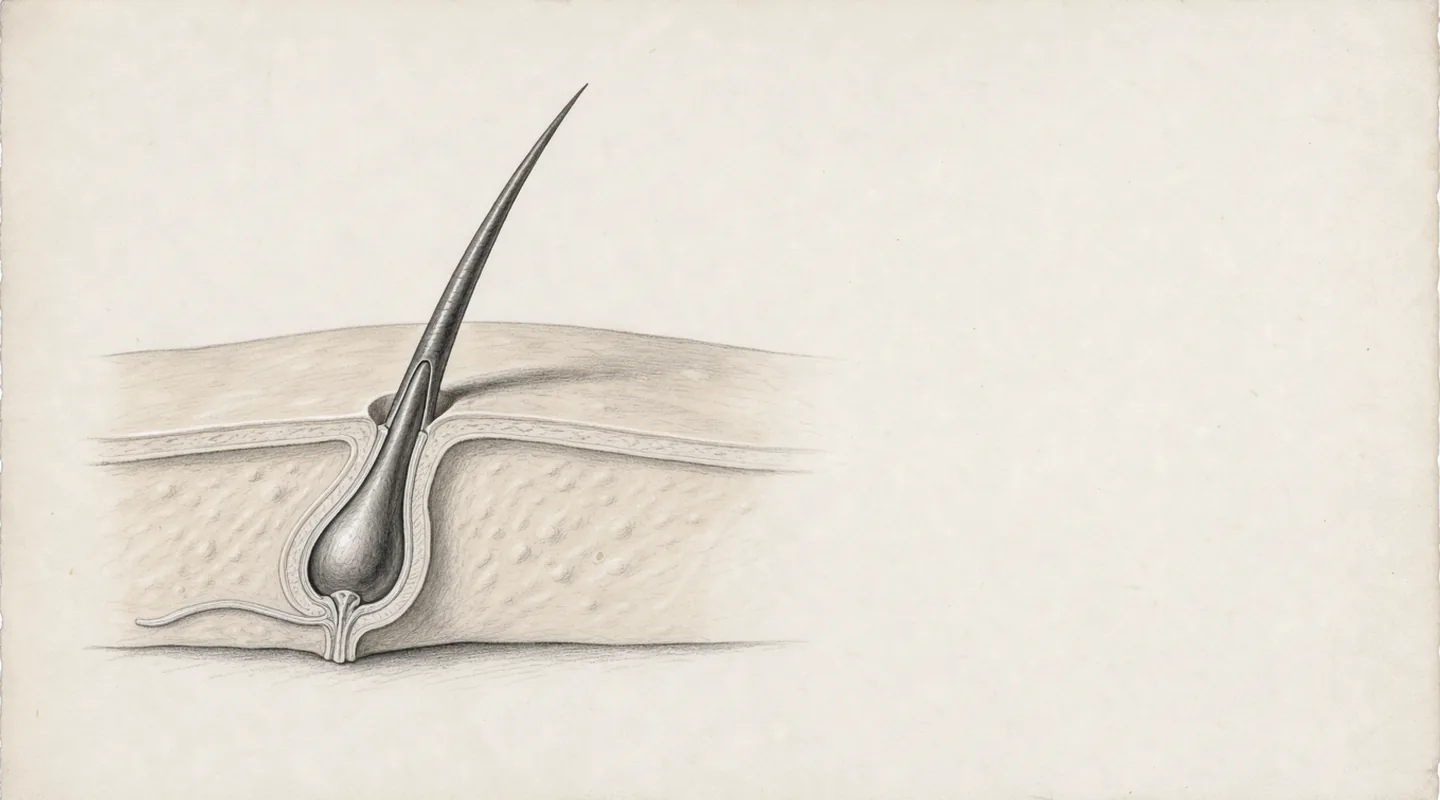
Another paper, the hair-follicle experiment published in 2007, tested AHK-Cu, the alanyl analog of GHK-Cu. Its experimental subjects were isolated human hair follicles and dermal papilla cells, the cells at the follicle base. These were ex vivo and cell-culture experiments.
The study reported follicle elongation and dermal papilla cell proliferation, with reduced apoptosis. Apoptosis is a controlled form of cell death. It is an interesting result for AHK-Cu and useful context for the copper-peptide family.
Those initials deserve their full share of attention. AHK-Cu and GHK-Cu name different compounds; the human combination trial used GHK. I don’t want a pleasing family resemblance to erase the identity of the material actually tested.
Credit for the combination
My verdict is modestly favourable toward the combination trial’s reported hair-count result. A controlled human finding warrants attention. The credit remains attached to that formulation, and the AHK-Cu experiment stays attached to its own compound and laboratory setting.
This is where the word “good” becomes pleasantly demanding. A useful result can survive a precise description. It gains nothing from being transferred to a different ingredient. For another version of that attribution problem, the gene-data essay follows GHK into a very different kind of measurement.