Barrier
GHK and the skin barrier
Before the attractive cellular story can become a topical story, something has to get through skin.
Copper on either side
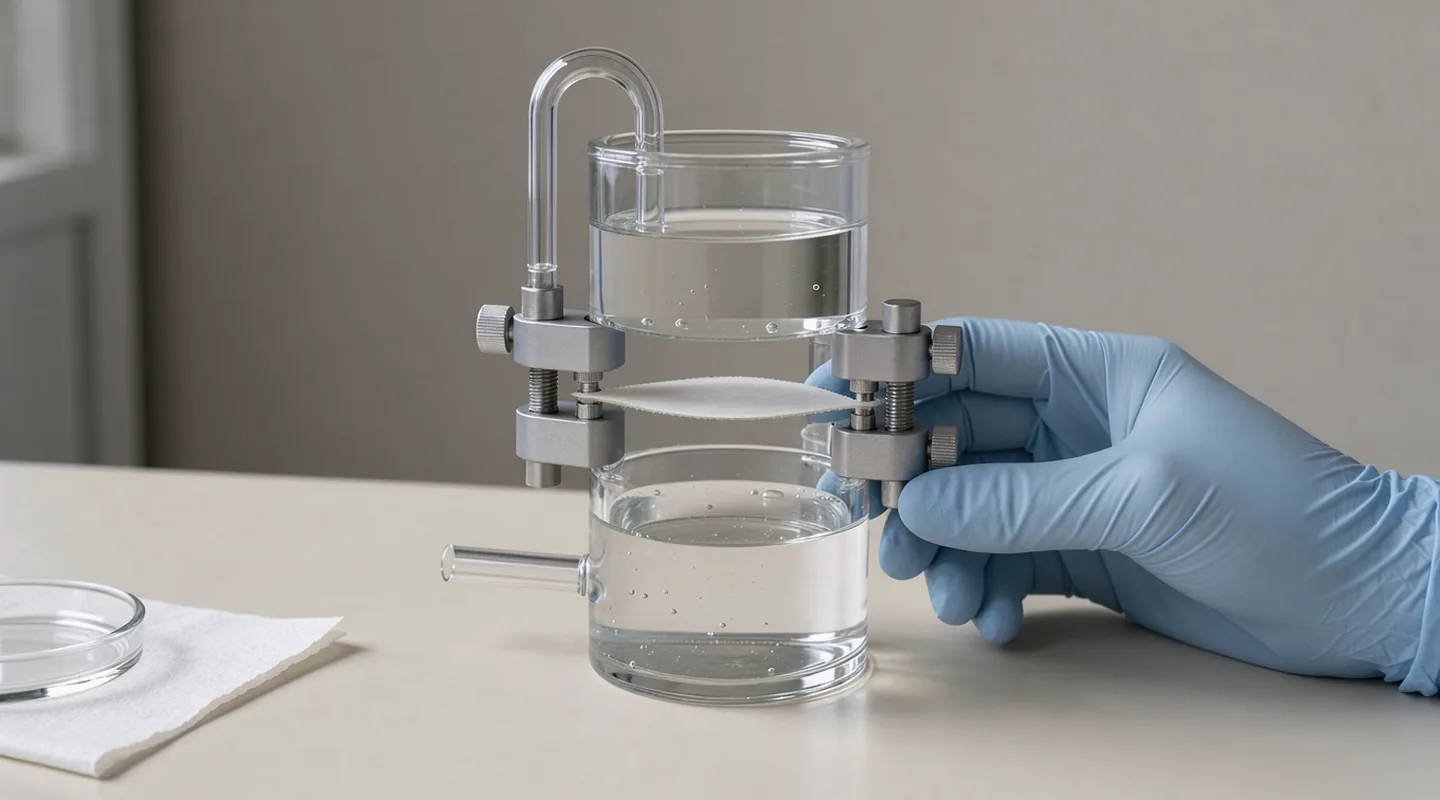
The human skin-layer penetration study applied copper as the GHK-Cu tripeptide and measured its movement through skin outside the body. This is ex vivo work: tissue studied after removal from the body. The researchers measured copper passing through and copper retained in the skin.
I enjoy the stubborn literalness of this experiment. A substance begins on one side of a barrier; measurements ask how much reaches another place. That brings the discussion of topical peptides back to a physical problem, where a good cellular effect still needs a plausible route to its target.
The finding concerns copper transport under the study conditions. The reported quantities describe copper, so I resist quietly translating them into quantities of intact GHK-Cu reaching living tissue.
What the experiment measured
Over 48 hours, 136.2 +/- 17.5 ug/cm^2 of copper permeated, while 97 +/- 6.6 ug/cm^2 was retained as a dermal depot. The reported permeability coefficient for dermatomed skin was 2.43 +/- 0.51 x 10^-4 cm/h. Dermatomed skin is skin prepared to a specified thickness for testing.
The retained material matters as much to this story as the material that crossed. The study gives topical-delivery research a local-depot question to investigate. Reproducing these quantities with a particular cream would take another experiment; transferring them to another route of administration would take a different case altogether.
These are unusually tangible numbers in a field full of expansive adjectives. They specify a material, an area and an experimental period. I would sooner discuss that bounded result than call a formulation “deeply penetrating” without saying what was measured.
A water-loving peptide
The topical GHK review published in 2025 identifies poor stratum-corneum permeability as a central delivery challenge. The stratum corneum is the outer barrier layer of skin. The review reports GHK’s calculated lipid–water partition value, clogP, as -2.24: a way of expressing its preference for a watery environment.
That preference is a useful bit of chemistry to carry into a discussion of skin delivery. The same review evaluates palmitoylation, which modifies GHK, and microneedle pretreatment as strategies for improving transport. Those approaches change the formulation or the barrier being studied. Their results need those circumstances attached.
I’m partial to this less glamorous part of the research. Formulation can sound like a finishing touch until the barrier becomes the main obstacle. Here it deserves a place near the beginning of the argument.
Future topical studies
The experiment I’d put next on the list asks a deliberately narrow question: can a topical preparation show both useful delivery and a reproducible skin outcome under the same conditions? The topical review brings efficacy and the delivery problem into the same discussion, which makes it a productive starting point.
The collagen experiment supplies a cellular reason for interest. This page supplies the physical interruption. Together, they turn an inviting possibility into a practical question I can get absorbed in: how to get the material through the barrier.